
Concept
Veryl is a hardware description language based on SystemVerilog, providing the following advantages:
Optimized Syntax
Veryl adopts syntax optimized for logic design while being based on a familiar basic syntax for SystemVerilog experts. This optimization includes guarantees for synthesizability, ensuring consistency between simulation results, and providing numerous syntax simplifications for common idioms. This approach enables ease of learning, improves the reliability and efficiency of the design process, and facilitates ease of code writing.
Interoperability
Designed with interoperability with SystemVerilog in mind, Veryl allows smooth integration and partial replacement with existing SystemVerilog components and projects. Furthermore, SystemVerilog source code transpiled from Veryl retains high readability, enabling seamless integration and debugging.
Productivity
Veryl comes with a rich set of development support tools, including package managers, build tools, real-time checkers compatible with major editors such as VSCode, Vim, Emacs, automatic completion, and automatic formatting. These tools accelerate the development process and significantly enhance productivity.
With these features, Veryl provides powerful support for designers to efficiently and productively conduct high-quality hardware design.
Code Examples
Module Definition
// module definition
module ModuleA #(
    param ParamA: u32 = 10,
    const ParamB: u32 = 10, // trailing comma is allowed
) (
    i_clk : input  clock            , // `clock` is a special type for clock
    i_rst : input  reset            , // `reset` is a special type for reset
    i_sel : input  logic            ,
    i_data: input  logic<ParamA> [2], // `[]` means unpacked array in SystemVerilog
    o_data: output logic<ParamA>    , // `<>` means packed array in SystemVerilog
) {
    // const parameter declaration
    //   `param` is not allowed in module
    const ParamC: u32 = 10;

    // variable declaration
    var r_data0: logic<ParamA>;
    var r_data1: logic<ParamA>;
    var r_data2: logic<ParamA>;

    // value binding
    let _w_data2: logic<ParamA> = i_data;

    // always_ff statement with reset
    //   `always_ff` can take a mandatory clock and a optional reset
    //   `if_reset` means `if (i_rst)`. This conceals reset porality
    //   `()` of `if` is not required
    //   `=` in `always_ff` is non-blocking assignment
    always_ff (i_clk, i_rst) {
        if_reset {
            r_data0 = 0;
        } else if i_sel {
            r_data0 = i_data[0];
        } else {
            r_data0 = i_data[1];
        }
    }

    // always_ff statement without reset
    always_ff (i_clk) {
        r_data1 = r_data0;
    }

    // clock and reset can be omitted
    // if there is a single clock and reset in the module
    always_ff {
        r_data2 = r_data1;
    }

    assign o_data = r_data1;
}
Interface Definition
// interface definition
interface InterfaceA #(
    param ParamA: u32 = 1,
    param ParamB: u32 = 1,
) {
    const ParamC: u32 = 1;

    var a: logic<ParamA>;
    var b: logic<ParamA>;
    var c: logic<ParamA>;

    // modport definition
    modport master {
        a: input ,
        b: input ,
        c: output,
    }

    modport slave {
        a: input ,
        b: input ,
        c: output,
    }
}

module ModuleA (
    i_clk: input clock,
    i_rst: input reset,
    // port declaration by modport
    intf_a_mst: modport InterfaceA::master,
    intf_a_slv: modport InterfaceA::slave ,
) {
    // interface instantiation
    inst u_intf_a: InterfaceA [10];
}
Package Definition
// package definition
package PackageA {
    const ParamA: u32 = 1;
    const ParamB: u32 = 1;

    function FuncA (
        a: input logic<ParamA>,
    ) -> logic<ParamA> {
        return a + 1;
    }
}

module ModuleA {
    let a : logic<10> = PackageA::ParamA;
    let _b: logic<10> = PackageA::FuncA(a);
}
Features
Real-time diagnostics
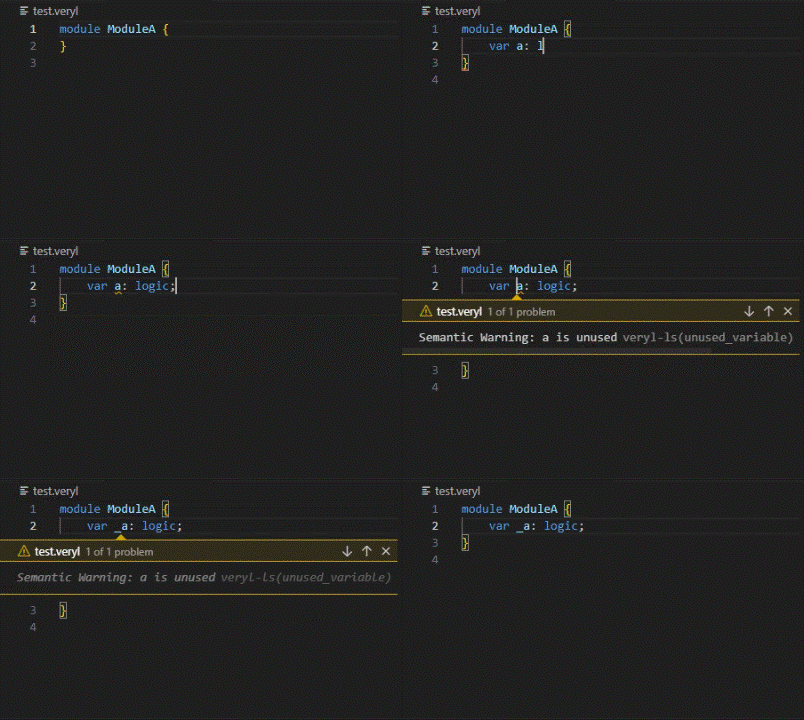
Issues such as undefined, unused, or unassigned variables are notified in real-time while editing in the editor.
In the following example, adding the _ prefix to variables flagged as unused explicitly indicates their unused status, suppressing warnings.
Auto formatting
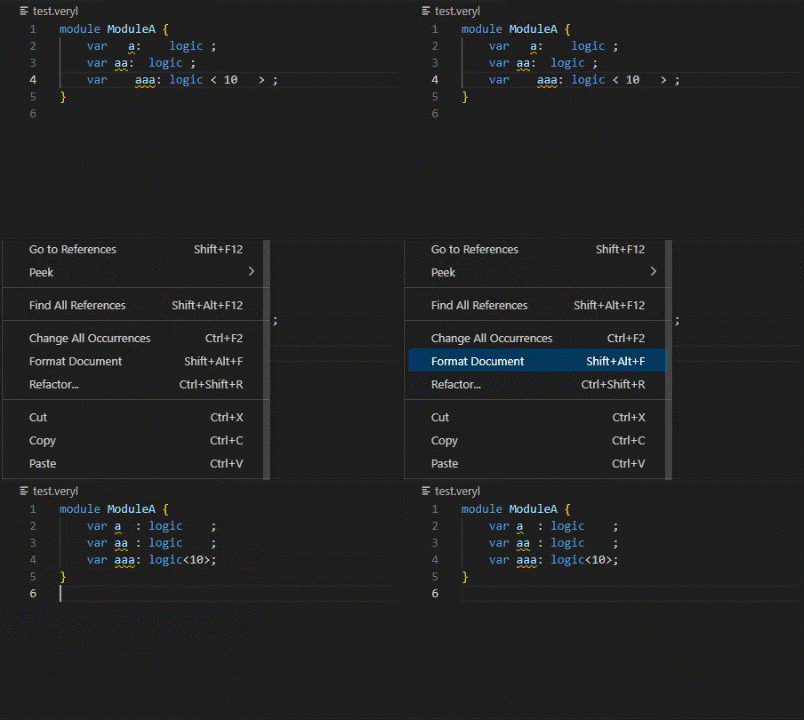
In addition to the automatic formatting feature integrated with the editor, formatting through the command line and formatting checks in CI are also possible.
Integrated test
Testbenches can be written directly in Veryl using its native testbench syntax,
and executed through the veryl test command.
$tb::clock_gen and $tb::reset_gen provide clock and reset generation,
and initial blocks describe test scenarios.
Individual tests can be skipped with the #[ignore] attribute.
#[test(test_counter)]
module test_counter {
    inst clk: $tb::clock_gen;
    inst rst: $tb::reset_gen (
        clk: clk,
    );

    var cnt: logic<32>;

    inst dut: Counter (
        clk: clk,
        rst: rst,
        cnt: cnt,
    );

    initial {
        rst.assert(clk);
        clk.next  (10);
        $assert   (cnt == 32'd10);
        $finish   ();
    }
}
$ veryl test
[INFO ]    Executing test (test_counter)
[INFO ]    Succeeded test (test_counter)
[INFO ]    Completed tests : 1 passed, 0 failed
Existing test code written in SystemVerilog or cocotb can also be embedded in Veryl code as a fallback.
#[test(test1)]
embed (inline) sv{{{
    module test1;
        initial begin
            assert (0) else $error("error");
        end
    endmodule
}}}
Dependency management
Veryl includes a built-in dependency management feature, allowing for easy incorporation of libraries by simply adding the repository path and version of the library on project settings like below.
[dependencies]
"https://github.com/veryl-lang/sample" = "0.1.0"
Standard library
Veryl ships a standard library providing generic interface and package definitions for common bus protocols. Parameterize the package once, then reuse the interface across modules.
alias package axi3_pkg = $std::axi3_pkg::<32, 4, 8>;

module ModuleA (
    slv_if: modport $std::axi3_if::<axi3_pkg>::slave,
) {}
The standard library currently includes AXI3, AXI4, AXI4-Lite, and AXI-Stream interfaces. See the standard library reference for the full list.
Logic synthesis support
A built-in logic synthesis pass converts the analyzer IR into a gate-level IR and applies constant propagation, logic compression, and typical arithmetic construction (adders, multipliers). This lets designers check approximate timing critical paths and area without reaching for an external synthesizer.

SystemVerilog translation
A new translate command converts existing SystemVerilog sources into Veryl, smoothing the
migration path from established SystemVerilog projects.

Generics
Code generation through generics achieves more reusable code than traditional parameter override. Parameters in function like the following example, but also module names of instantiation, type names of struct definition, and so on can be parameterized.
| SystemVerilog | Veryl |
|---|---|
|
|
Type inference
The type of a let binding or var assignment can be inferred from the right-hand side
or from function arguments. Generic type parameters are also inferred from call-site arguments
when unambiguous, so explicit ::<...> is no longer required in common cases.
| Explicit | Inferred |
|---|---|
|
|
Integer types
In addition to u32 / i32 / u64 / i64, Veryl provides fixed-width primitive types
u8, u16, i8, i16 for smaller bit widths, and p8, p16, p32, p64 for
positive-only integers (restricted to non-negative values).
let a: u8  = 0;
let b: u16 = 0;
let c: i8  = 0;
let d: i16 = 0;

module ModuleA {
    const X: p32 = 10;
}
Inferable enum width
When the base type of an enum is omitted, it previously defaulted to logic.
A new syntax lets you specify the base type while still inferring its width from the variants.
enum A: bit<_> {
   X,
   Y,
}

enum B: logic<_> {
   X,
   Y,
}
Global function
Functions can be defined at the project root, outside of module, interface, and package.
Global functions support generic type parameters and can be exposed with pub.
pub function add::<W: u32> (
    a: input logic<W>,
    b: input logic<W>,
) -> logic<W> {
    return a + b;
}

module ModuleA #(
    param WIDTH: u32 = 8,
) (
    i_a: input  logic<WIDTH>,
    i_b: input  logic<WIDTH>,
    o_c: output logic<WIDTH>,
) {
    assign o_c = add::<WIDTH>(i_a, i_b);
}
Clock Domain Annotation
If there are some clocks in a module, explicit clock domain annotation and unsafe (cdc) block at the clock domain boundaries are required.
By the annotation, Veryl compiler detects unexpected clock domain crossing as error, and explicit unsafe (cdc) block eases to review clock domain crossing.
| SystemVerilog | Veryl |
|---|---|
|
|
Variables without explicit clock domain annotation can be inferred from their context. For example, when a variable is assigned from a signal with a known clock domain, the variable's domain is automatically inferred.
module ModuleA (
    i_clk_a: input  'a clock,
    i_rst_a: input  'a reset,
    i_dat_a: input  'a logic,
    o_dat_a: output 'a logic,
) {
    var x: logic;
    assign x = i_dat_a;   // x is inferred as 'a domain
    assign o_dat_a = x;
}
Abstraction of clock and reset
There is no need to specify the polarity and synchronicity of the clock and reset in the syntax; these can be specified during build-time configuration. This allows generating code for both ASICs with negative asynchronous reset and FPGAs with positive synchronous reset from the same Veryl code.
Additionally, explicit clock and reset type enables to check whether clock and reset are correctly connected to registers.
If there is a single clock and reset in the module, the connection can be omitted.
| SystemVerilog | Veryl |
|---|---|
|
|
Visibility control
Modules without the pub keyword cannot be referenced from outside the project
and are not included in automatic documentation generation.
This allows distinguishing between what should be exposed externally from the project and internal implementations.
| SystemVerilog | Veryl |
|---|---|
|
|
Documentation comment
Writing module descriptions as documentation comments allows for automatic documentation generation. You can use not only plain text but also the following formats:
| SystemVerilog | Veryl |
|---|---|
|
|
let statement
There is a dedicated let statement available for binding values simultaneously with variable declaration,
which can be used in various contexts that were not supported in SystemVerilog.
| SystemVerilog | Veryl |
|---|---|
|
|
if / case expression
By adopting if and case expressions instead of the ternary operator,
readability improves, especially when comparing a large number of items.
| SystemVerilog | Veryl |
|---|---|
|
|
Range-based for / inside / outside
With notation representing closed intervals ..= and half-open intervals ..,
it is possible to uniformly describe ranges using for, inside, and outside (which denotes the inverse of inside).
| SystemVerilog | Veryl |
|---|---|
|
|
<> operator
<> operator can connect two interfaces. It simplifies SystemVerilog's interface connection requiring each member assignments.
| SystemVerilog | Veryl |
|---|---|
|
|
Trailing comma
Trailing comma is a syntax where a comma is placed after the last element in a list. It facilitates the addition and removal of elements and reduces unnecessary differences in version control systems.
| SystemVerilog | Veryl |
|---|---|
|
|
Named block
You can define named blocks to limit the scope of variables.
| SystemVerilog | Veryl |
|---|---|
|
|
msb notation
The msb notation, indicating the most significant bit, eliminates the need to calculate the most significant bit from parameters, making intentions clearer.
| SystemVerilog | Veryl |
|---|---|
|
|
repeat of concatenation
By adopting the explicit repeat syntax as a repetition description in bit concatenation,
readability improves over complex combinations of {}.
| SystemVerilog | Veryl |
|---|---|
|
|
Compound assignment operator in always_ff
There is no dedicated non-blocking assignment operator;
within always_ff, non-blocking assignments are inferred, while within always_comb, blocking assignments are inferred.
Therefore, various compound assignment operators can be used within always_ff just like within always_comb.
| SystemVerilog | Veryl |
|---|---|
|
|
Individual namespace of enum variant
Variants of an enum are defined within separate namespaces for each enum, thus preventing unintended name collisions.
| SystemVerilog | Veryl |
|---|---|
|
|