
Veryl Simulator: Performance Comparison with Verilator
2026-05-26
We have been working on a native Veryl simulator built on the new IR-based analyzer introduced earlier this year. This post shares early performance numbers comparing it against Verilator, the de facto standard open source SystemVerilog simulator.
Approach
The Veryl simulator combines two execution backends:
- A Cranelift-based backend that trades optimization quality for compile speed, so the first run starts with little upfront cost.
- A GCC-based backend that runs in the background to produce a more heavily optimized binary. Once the optimized binary is ready, the running simulation switches over to it dynamically.
In practice the simulation starts running almost immediately on the Cranelift output, and then speeds up mid-run once GCC has finished compiling.
Benchmark
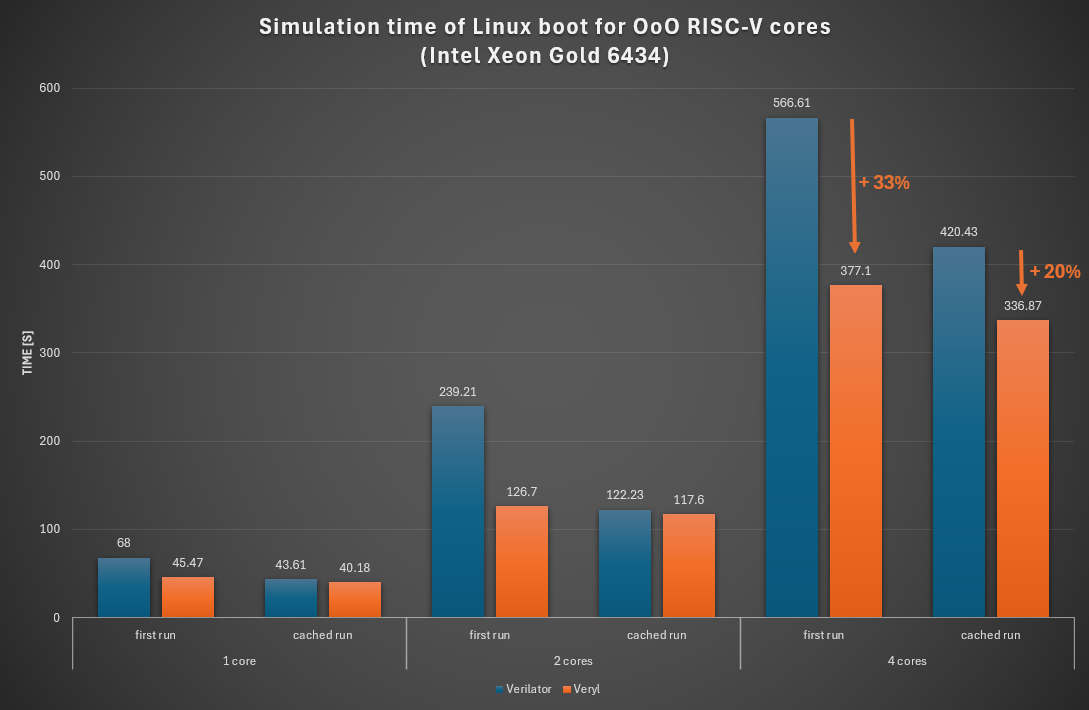
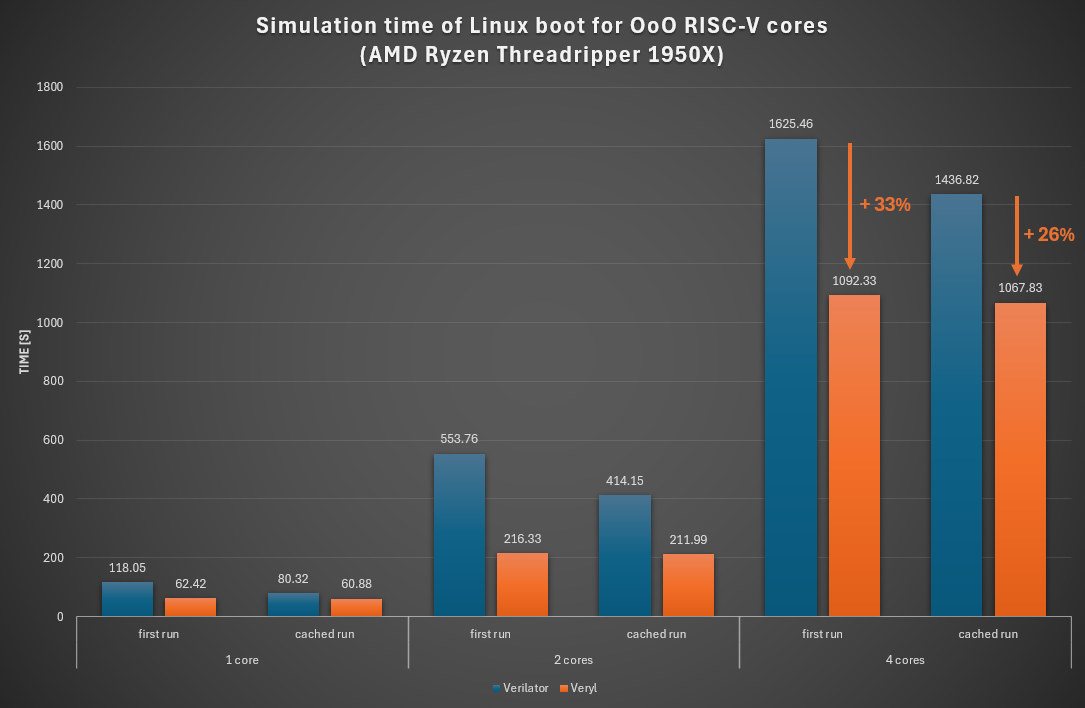
We ran a Linux boot (about 30M simulated cycles) on Heliodor, an Out-of-Order RISC-V core written in Veryl, with 1, 2, and 4 core configurations.
- Veryl: latest nightly (2026-05-26)
- Verilator: v5.040
The Veryl simulator also supports 4-state simulation. We used 2-state mode for this benchmark because this version of Verilator is 2-state only.
For each configuration we measured both the first run (no cached artifacts) and the cached run (re-running after the optimized binary has been built), on two machines representing different CPU generations.
Intel Xeon Gold 6434 (Sapphire Rapids, 2023)
AMD Ryzen Threadripper 1950X (Zen 1, 2017)
Observations
- On the first run, Cranelift's fast compilation lets Veryl start executing noticeably sooner than Verilator, which spends a significant portion of the wall-clock time on C++ compilation. The first-run improvement ranges from about 33 % to 61 % across the two machines.
- On the cached run, both simulators reuse a previously built native binary, so the comparison is between the GCC-optimized output of each toolchain. Veryl is still consistently faster.
- Across CPU generations, the gap is larger on the older Threadripper 1950X (Zen 1) than on the Xeon Gold 6434 (Sapphire Rapids) — the smallest cached-run cases shrink to 4–8 % on Sapphire Rapids but stay at 24–49 % on Zen 1. We suspect Verilator's generated C++ is more sensitive to older microarchitectures than the Veryl backends.
Veryl is faster than Verilator in both modes: substantially on the first run, and more modestly on the cached run. Most edit-compile-run cycles during development are dominated by the first-run number. Once a simulation runs long enough — regression sweeps, full OS boots — the cached-run number takes over.
What's next
The simulator is still under active development. We plan to extend the benchmark to other CPU architectures and a wider range of designs, and to publish the benchmark setup so the numbers can be reproduced.